
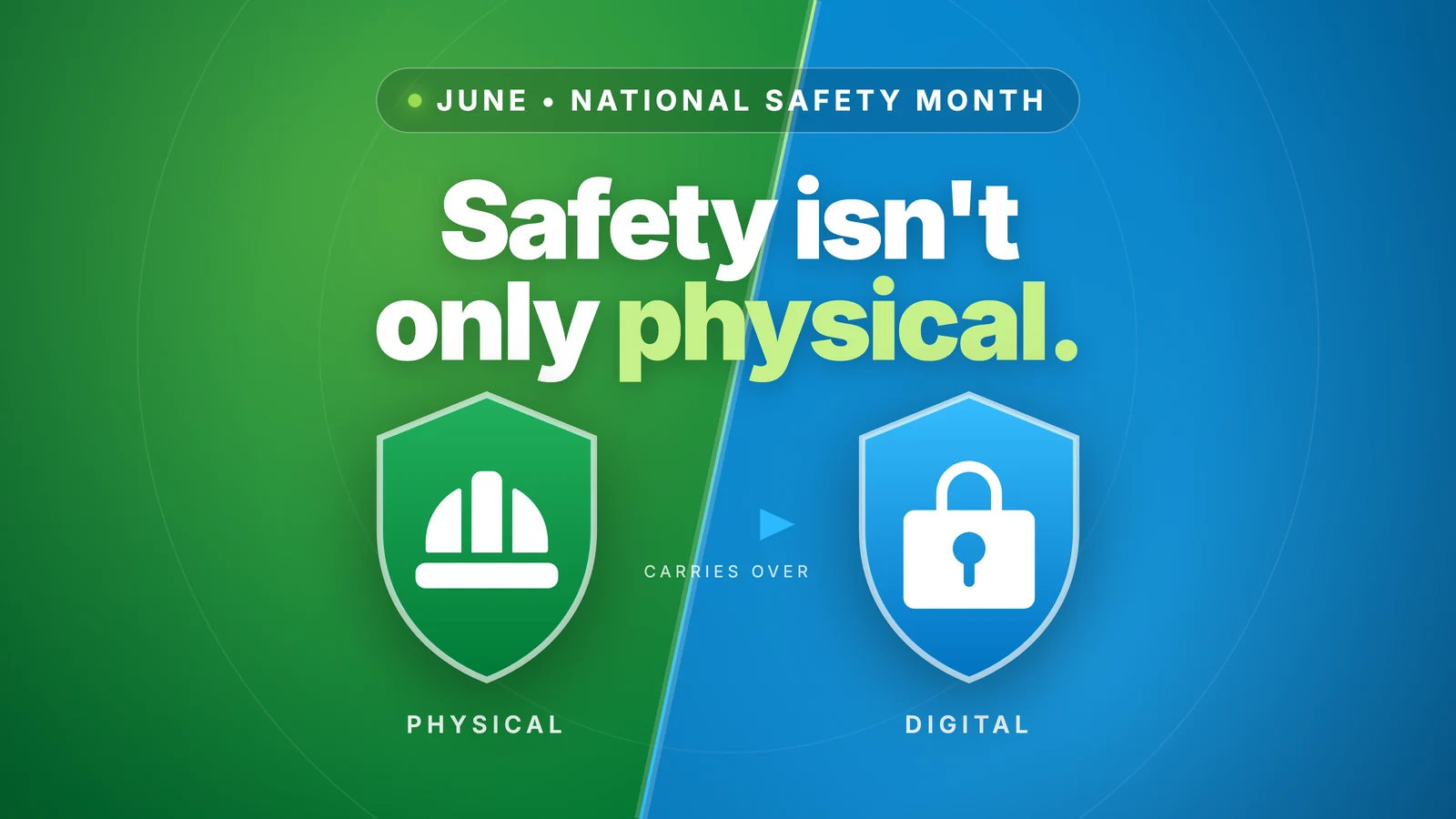
Every June, the National Safety Council marks National Safety Month - a reminder to look closely at the risks we live with and take simple steps to prevent harm. Most of us picture physical safety: a clear walkway, a well-kept vehicle, the right gear for the job. That work matters. But in 2026, much of what we need to protect no longer has a physical form at all.
Your identity, your financial records, your private messages, the documents you would never hand to a stranger - they all live as data. And data can be lost, exposed, or stolen as surely as anything in the physical world. The encouraging part is that the habits behind physical safety carry over almost directly. The mindset is the same. Only the hazards have changed.
Here is how the principles of National Safety Month apply to the data you handle every day.
Recognize the hazards you cannot see
Safety begins with hazard recognition: noticing the wet floor before someone slips. Digital hazards are harder to spot because they are invisible by design. When you delete a file or clear your browser history, the data usually does not disappear. It stays on the drive, recoverable, until something else happens to overwrite it. Meanwhile your computer keeps quiet records of where you have been and what you have opened - caches, temporary files, thumbnails, logs - long after you think they are gone.
You cannot manage a risk you do not know about. The first step is simply understanding that "delete" rarely means "gone." Clearing these traces regularly, and clearing them so they cannot be recovered, keeps the risk from building up - the same way you would wipe up a spill instead of stepping around it.
Dispose of dangerous things safely
Safe disposal is one of the oldest ideas in safety. You do not throw hazardous material in with the regular trash. Yet every year people sell, donate, or recycle old computers and phones with their data still on them. A factory reset or a quick format feels final, but it often leaves the data recoverable by anyone who knows where to look.
Before a device leaves your hands, the drive should be wiped so nothing personal can be pulled back off it. Treat your old data like the hazard it can become once it belongs to someone else.
Lock up what is valuable
Workplaces lock up tools, cash, and anything dangerous or worth stealing. Your most sensitive files deserve the same treatment. Encryption is the digital lock: it scrambles a file so that, without the key, it is useless to whoever finds it. The documents that would do real damage if exposed - financial, legal, medical, personal - belong behind a strong lock, not sitting in the open on a desktop.
Use strong keys, and do not share them
A lock is only as good as its key. Weak, reused passwords are the digital equivalent of leaving the key under the mat. Use a long, unique password for every important account, keep them somewhere safe rather than in your head or on a sticky note, and turn on two-step verification wherever it is offered. It is the easiest habit to adopt, and it pays off the most.
Safety is a shared responsibility
National Safety Month makes one more point worth carrying over: safety is never one person's job. At home and at work, we look out for each other. Share these habits with the people around you - the family member who reuses the same password everywhere, the colleague about to donate an old laptop, the parent who assumes deleting a file is the end of it. A safer digital world is one we build together.
This June, add a few minutes of digital safety to your routine: clear what you no longer need, lock up what matters, wipe your devices before they leave your hands, and strengthen your keys. The same care that keeps you safe in the physical world will keep your data safe in the digital one.
At East-Tec, this has been our work for more than 27 years - building tools like east-tec Eraser, east-tec DisposeSecure, and east-tec SafeBit that help people clear, wipe, and lock down their data with confidence.